Friday, April 6, 2012

Amdavad, Ambaji and Abu Trip

March 2012 as usual my trip to Mount Abu happened with a small Twist. I planned this trip with Somnath, Dwarka and Abu, but due to unavailable of leave I trimmed my tour plan to 7 days without Somnath and Dwarka. I went this time by Air up to Amdavad and from there by Train to Abu Road.

Places Visited in this trip are Amdavad, Ambaji and Abu.


Amdavad
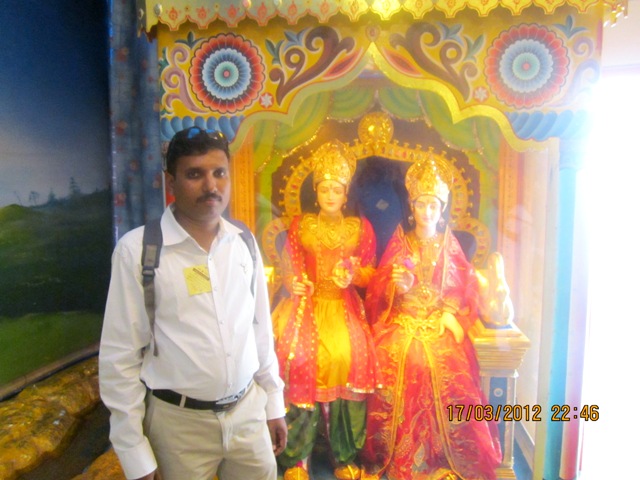
First I went to  Akshardham Swaminarayan Temple. It was one of the largest temple complex in India. It consists of Temple Complex, Exhibition complex and Gardens with Musical Fountain. we have to spend around 3-4 hours to see the entire temple complex.

Akshardham is a place of education, entertainment and enlightenment. As one of the wonders of world, it combines traditional stone architecture, ancient wisdom, and the best of modern technology to create the most powerful experience of Indian Culture ever to exist. Dedicated to Lord Swaminarayan, and inspired by HDH Pramukh Swami Maharaj, Akshardham is a miracle worked by the sacrifice of thousands of volunteers. Hundreds of figures, dioramas, displays and audio-visual shows, unfold a stream of timeless experiences. They are visually mesmeric, scientifically stunning, and spiritually moving.
More than 2 million visitors visit annually. But remember, at Akshardham you are not a tourist nor a traveler. You're an explorer. An inventor, A sculptor. You'll discover the art of sculpting yourself from within.

Akshardham complex comprises of Monument:
An architectural masterpiece that enshrines the golden Murti of Lord Swaminarayan.
Exhibitions:
Experiential exhibitions that display the values of Indian Culture. Entry Fee : Rs.55 per Adult
Garden:
15 acres of contemplative garden with cultural spots.
Research Center:
A futuristic research institute for social harmony.
  
How to get there:
Akshardham sits in the heart of one of the greenest cities of the world -Gandhinagar, which is located on National Highway 8c. Therefore, Akshardham is accessible from every direction.
On your way to Jaipur or Udaipur, Dwarika or Somnath, Modhera or Mt. Abu.

Distance by road from important locations: 

By Road:
Special buses and cars are provided by the tourism department, government authorities and private services.
Ahmedabad - 25 km Vadodara - 150 km Jaipur - 604 km  Udaipur - 230 km
Mt. Abu - 190 km Mumbai - 540 km Delhi - 900 km
By Air:
23 km from national and international airports of Amdavad.

By Railway:
2 km from Gandhinagar railway station.
31 km from Amdavad railway station.


   Amdavad Akshardham Temple


After that we went to Vaishnao Devi temple in the evening near Gandhi Nagar.

Amdavad Vaishnao Devi Temple

The next day we reached Abu Road and from there we went to Ambaji temple.

About Ambaji


Ambaji is a census town in Banaskantha district in the state of Gujarat, India. Ambaji is an important temple town with millions of devotees visiting the Ambaji temple every year. It is one of the 51 Shaktipeeths.
Ambaji mata temple is a major Shakti Peeth of India. It is situated at a distance of approximately 65 kilometers from Palanpur and 45 kilometers from Mount Abu and 20 kilometers from Abu Road near the Gujarat and Rajasthan border. The original seat of Ambaji mata is on gabbar hilltop in the town. A large number of devotees visit the temple every year specially on Purnima days. A large mela on Bhadarvi poornima (full moon day) is held.
In the holy temple of "arasuri ambaji" there is no image or statue of goddess the holy "shree visa yantra" is worshiped as the main daity. No one can see the yantra with naced eye. the photography of the yantra is probhited.
Ambaji town is known for possessing mines which produce fine quality marble and granite.

Photography /camera are not inside the temple, so I taken some snaps from out side.


Maa Ambaji Temple - AMBAJI


Maa Ambaji at Gabbar Hills

The famous mountain of Gabbar is situated on the border of States of Gujarat and Rajasthan, near the flow of the origin of the famous Vedic virgin river SARASWATI, on the hills of Arasur in forest , towards south-west side to ancient hills of Arvalli, at the altitude of about 480 meters, at about 1,600 feet (490 m) high from sea level, having at 8.33 km² (5 sq. miles area ) area as a whole, and it is in fact One of the Fifty One (51) famous Ancient Pauranik Shakti Piths - The Centre of Cosmic Power of India and it is the original holy place of Mata Ambaji, where the piece of the heart of the dead body of Devi Sati fell at the top of this holy hill of Gabbar as per the legend narrated in the "Tantra Chudamani". The Mountain or Hill of Gabbar has also a small temple fortified from the western side and there are 999 steps to go up to the mountain and reach this holy temple at the top of Gabbar Hill. A Holy Lamp is constantly burning on this hill temple facing exactly in front of Visa Shree Yantra of Nij Mandir of Mata Shri Arasuri Ambica. There are many more beautiful Site Seeing Places on Gabbar together with a sunset point, Cave and Swings of Mataji and Trips through Ropeway. Rope car charges Rs.85 per person to and fro.

Maa Ambaji Temple at Kabbar Hills
   
Kabbar Hills - Rope car
Kabbar Hills - Steps


About Kumbharia Jain Temples

Kumbharia Jain temples is a fascinating group of amazing temple structures at Ambaji town which dates back to the 11th and 13th century, respectively. The Kumbhariya group of Jain temples are dedicated to the five theerthankkaras of the jain religion namely Mahavira, Parshvanath, Neminath Shantinath and Sambhavanath. According to the legend, Mata Ambika had directed Sheth Vimal Shah, the 11th century minister of the Solankis, to construct 360 Jain temples there. The temples were constructed without Ambe Mata’s idols installed. On noticing this, the goddess got furious and destroyed almost all the temples except five of them. The minister realized his mistake and included the idols of Ambe Mata in the remaining temples.
The main shrine constructed in the center of a rectangular courtyard is the highlight of the temple. The beautiful shiksaras, balconies with porches and the excellent craftsmanship and artistic of the temple structure and style bears a striking resemblance to the famous Dilwara temples of Mount Abu in Rajasthan.
 
Khumbaria Jain Temples - Ambaji


On 18th March we went to Abu darshan by car and we seen lots of places in Mount abu.

Abu Road, Rajasthan
Brahmakumaris - Shantivan Complex
Diamond Hall - 20,000 Capacity Hall Jampacked
Vegetable Cutting Machine
Vegetable Ready for Cooking
Universal Peace Hall

Roti Making Manually
Roti Making Machine
Cooking with out Fire
Utensil cleaning by Rajasthani Womens
Shantivan Part View

Brahmakumaris - Gyansarovar, Mount Abu

Spritual Art Galary - Gyansarovar
Gyansarovar Park
Mount Abu Road
Gyansarovar Hill Area
Mind Power checking Computer

Brahmakumaris - Pandav Bhavan, Mount Abu


Gurusigarh - Mount Abu
Gurusighar - Radar Station - 5200ft
Gurusighar - 5000ft
Gurusighar - Scientist's Center - 5200ft
Gurusighar - Historic Bell - 5200ft
Nakki Lake Boating - Mount Abu
Playing in Peace Park

By return I came by flight so I started in the morning from Abu road by car to reach Amdavad Airprt. It takes 4 hours to reach Amdavad from abu Road. We reached 2.00 pm in Airport and my flight was 3.10 pm. Finally I reached Chennai in the evening 5.30 pm. I taken some photos from flight are here.


 Clouds at 39000ft
Inside Flight
Thank you for your visit to my blog.


Tuesday, March 27, 2012

Pulicat Lake Trip

I started my 2012 New year with a Pulicat lake (In Tamil:Pazhaverkaadu Eri பழவேற்காடு ஏரி) trip. Few of the photos and my experiences are here for you!

We started from Chennai by 10 am by our Car to this place. It is around 60-65km to reach Pulicat lake. On the way to Pulicat first we went to Siruvapuri Murugan Temple. It is a famous and beautiful Murugan temple in the outskirts of Chennai.


Siruvapuri Murugan Temple


Then we proceed to Pulicat via Ponneri and reached there by 1.00 pm. We had a nice time in the beach. At that time boating was not allowed due to recent tragedy accident in that lake.

About Pulicat Lake

Pulicat Lake is the second largest brackish lagoon on the Indian subcontinent, covering a total area of 720sq.km of which 84% falls in Andhra Pradesh and 16% falls in Tamilnadu. The lake is shallow with a mean depth of only 1 – 2 meter. The lagoon is about 60km in length and its breadth varies from 0.2 to 17.5km . During the monsoon period starting in August or September, Pulicat Lake is filled by nutritious water and large numbers of both phytoplankton and zoo-plankton are present in the lake. These microscopic organisms constitute essential food for invertebrates and fish. As a result, tens of thousands of wetland birds are attracted to the lake because of large amounts of food.


Pulicat Beach

Other Important Bird viewing points:
  • Central part of the lake between Sriharikota and Kudiri.This area is Important between November to February, specially in drying seasons it attracts large number of birds around the culverts along the Sullurpeta—Sriharikota road.
  • Another area is Moolah Kuppam on the western edge of Pernadu Island especially after the Kudiri-Sriharikota stretch dries up, where you can see the greater flamingo almost through out the year.
  • Another Important area is Annamalcheri at the southern end. This is the another site in Pulicat lake where the greater flamingo can be seen almost throughout the year.

Pulicat Lake
The Pulicat sanctuary is drained by Arni river while the Buckingham canal brings in the city’s drainage water. At the southern end is an opening on to Bay of Bengal through a shallow mouth of 200 m in width. The rest of the lake is closed by a sand bar running parallel to the Bay of Bengal in the form of the Sriharikota Island.


Pulicat Bird Santuary

As such this place is not a famous tourist spot, you cannot find motorized boat rather, you have traditional punting or flat-bottom boats called as thoni in local language. You can hire one, for about 3-4 hours, from the local fishermen for Rs.500/ or less if you can bargain. Most of the things here are environmental friendly, which you can witness as you take a ride. You can watch various species of birds like waterfowl, notable pelicans, herons and flamingos, shorebirds, gulls and terns. 
Sailing slowly across the lake you come across another beautiful landmark - the lighthouse. For more adventure, if you move on towards northwards about 5 kms, you come to the lake's mouth where you have deep bumpy waters. Just opposite to this lake-mouth you have a small village Karimanal that is a historical site. This is the place where the Dutch and the British tied their ships. If you move further north about 35 kms, you come to densely wooded island of Sriharikota. 
Even here, you can watch thousands of large water-birds that stopover especially during winter. All-in-all, to get a real feel of the life at the lake, with overloaded ferry boats transporting fisher folk to the villages on the other side, boats landing fish-catches, tribal women picking prawns in the lake with their hands, bullock-carts crossing the water towards dusk to reach their destinations, visiting this place offer some of the rare and fascinating sites to be enjoyed.
Pulicat Bird Santuary

How to reach Pulicat

You have to drive on NH5 Kolkatta Highway; it is a straight Road to Tada which is approximately 60-65 kilometers away from the city. Ponneri is a nearest small town. MTC and STC Buses are flying to this place frequently.


On the way return to Chennai, we went Gnayiru Temple in the middle of the Gnayiru Village near Redhills.


Gnayiru Temple

Gnayiru temple is situated near Redhills. Pushparatheswarar Temple at Gnayiru village is one of the Navagraha temples around Chennai dedicated to Suryan. The village itself gets its name from Suryan or Sun God, Gnayiru in Tamil means Sun.

 
Gnayiru Temple


The temple is well maintained. I have found a rare tree in this temple, Thiruvodu (begging bowl of the sanyasis) is a half of the outer shell of the fruit of these trees.  It is also used by them to drink or eat food from and is believed to prevent viral infections.
Gnayiru Temple

There are a few interesting stories behind this temple.  A Chola King was returning after successfully waging a war on a kingdom in Andhra Pradesh.  He camped at Cholavaram.  He was a staunch Shiva devotee and went in search of lotus to perform his daily pooja.  During his search he saw a pond full of lotuses.  One of the flowers was taller, bigger and more beautiful than the rest.  The King wanted this flower for the pooja and tried to reach the flower.  As the King neared the flower it moved away and was elusive.  After several futile attempts, the King was very angry and threw his sword at the flower.  The sword broke into pieces.  One of the pieces fell on a Lingam which was in the pond.  The pond turned red in no time because of the blood that was oozing from the Lingam.  This scar can still be seen on this Shiva Lingam.  The King fainted there. His horse fled from the scene before fainting.  Lord Shiva then appeared before the King and blessed him.  The King apologized to the Lord.  Lord Shiva asked the King to build a temple for the Lingam that was found in the pond.  The Shiva Lingam is a Swayambhu (self-manifested).  Here, Lord Shiva is known as Pushparatheswarar.  His consort here is Swarnabigai.  The God is also known as Poothereeswarar.  Both the names convey the same meaning; Poo or Pushpam means flower and ratham or ther means chariot.  Since the Lingam was found in Lotus, He got this name. Lotus is the flower that is offered to the God here.


Gnayiru Temple Nandhi


Thiruvodu Tree


Sunset Near Gnayiru
How to Reach Gnayiru: There are MTC buses from Redhills and Koyambedu regularly to reach this place. It is about 10kms from Redhills and 20 Kms from chennai City.
 

Saturday, December 24, 2011

Coutralam and KanyaKumari - a Refreshing Visit

I have a thought on Long days that  I have to Visit Coutralam and Kanyakumari. I made one plan to cover these areas in 2 days weekend trip. I booked the train ticket 2 months back and visited by December 16th 2011 with my friend. It was a very refreshing trip for me in a mechanical life.
Kutralanathar Temple


About Coutralam


Coutralam water has medicinal properties since the water runs through the forests of herbs and the water has therapeutic qualities to cure physical ailments. During the season (period June to September in every year) thousands of tourists from far and near visit this place. This place has a chill and a superb climate with sizzling of rain drops over us removes the stresses in our mind. The pure wind that starts from pothigai malai (mountain) removes the tiredness from our body. 'The Fruit Garden falls' is the pampered kid of Courtallam. It is dedicated to Lord Thirukutralanathar (Siva). It is said that Lord Siva send saint Agasthiyar to the south to avoid imbalance due to overcrowding in the mount Kailas on his celestial wedding. 
Main Falls


Water Falls list in coutrallam 1. Peraruvi (Main Falls) The most popular and frequented waterfalls are the Main falls. Not only during the season, but also during the period November to January, the crest receives the Northeastern monsoon emptying itself on the slopes to swell the falls and the Chittar River. From a height of 300 ft., the Chittar River makes its last descent to the plains. 2. Chittraruvi Adjacent to the Main falls is a small cascade called 'Chittraruvi'. 3. Shenbaga Devi Falls A mile away from the Main falls is the Shenbagadevi falls, so called because of its location near to the temple of Shenbagadevi. During full moon days large crowds visit this temple. 4. Thenaruvi (Honey Falls) About 3 miles from the Main falls on the upper crusts of the rocks is the Honey falls. It is so called because of beehives on the promontory. It is a romantic place of solitude and those who seek seclusion come here to meditate on reality. 5. Aintharuvi (Five Falls) Connected by a good road about 3 miles from the Main falls are the Five falls, so named as the cascade spreads in five heads like a hooded cobra. This spot is venerated highly as it presents an image of Adishesha with several hoods. 6. Pazhathotta Aruvi 7. Puli Aruvi About 6 furlongs form the Main falls is the Tiger Falls with a temple for Shastha nearby. Bathing ghats have also been provided for pilgrims. 8. Pazhaya Courtallam About 4 miles from the Main falls is the Old falls, rarely frequented. Apart from all these falls the place is also famous for the Shiva shrive, Thirukootala nathar, ('Lord of three peaks'). 9. Puthu Aruvi Perched at an elevation of 1,00 ft, and one and half miles from the Main falls is the New falls amidst a sylvan landscape of wild forest. The panoramic view from this ledge is beautiful affording a sight of the entire town below. 


Coutralam Falls
Water Falls around Coutrallam: 1. Gundarau Falls 2. Kummaroutti falls 3. Paalaru 4. Agastiyar Falls 5. Baanatheertham. 


Temples in and around coutrallam: 1. Kutraleeswar Temple - Coutrallam 2. Kashivishwanathar Temple -Tenkasi 3. Kumaran Temple -Ilanji 4. Thirumalai Kumarasamy Temple -Tirumalai koil 5. Shenbaga devi Temple - Near Senbagadevi Falls 6. Anjaneyar Temple - Krishnapuram 7. Thoranamalai Temple.

Five Falls
We started from Chennai on Friday evening by Sengottai Exp (20.05pm)to reach Tenkasi first. From there we catched town bus to reach Coutralam (Fare Rs.6) . It is not a season in Coutralam but crowd was there due to Sabarimala season. Water also flowing from main falls is very good. Everybody said this is not the right season to visit coutralam(becoz water will not be more and it is a rainy/winter season), but i don't like crowd, so I planned this December. My plan was correct and I enjoyed my trip very well. I taken Oil massage there (Rs.140)and taken bath in main falls upto my thirst. The water was taken away all my pressures and relieved me  to light experience.


Five Falls


Then we went to 5 falls and taken some photos there. there is not much crowd and water was not that force as in Main falls. But good to bath there also without crowd. It is 5 kms away from Main falls and no connecting bus was there in non-season, so there is no crowd. There is share autos are reaching there for Rs.10 per head. If you need privacy in auto they ask Rs.100 for to and fro to 5 falls. 


Temple Entrance


After 5 falls we came back to Tenkasi and travelled by another bus to our next destination Nagercoil. (around 120km) We reached there by evening and went to Nagaraja Temple. (The Nagercoil name came from this temple). There some peoples are doing some rituals to remove their sins / dhosam. By Spreading turmeric powder and pouring milk to the Nager statues. In that temple mens are not allowed with shirts/Vests. They have to remove their Shirts to enter the temple. Because the temple is  under Kerala control some time back and they performing pooja in Kerala style now also.


Nagaraja Temple
In the late evening we went to Kanyakumari for Night Halt.(20Km). We went to Vivekananda Kendra first in Kanyakumari. The next day morning we wake up very early and refreshed ourselves and went to Sea to see Sunrise. It was cloudy in the morning so Sun was not seen upto 6.40 am. But there was lot of crowd was there, again due to sabarimala season. On 6.50am the Sun was risen and everybody enjoyed it. We saw Thiruvallur statue, Vivekanada Rock and Gandhi Mandapam there and came back to our place. That day there is heavy wind was there and somebody said, boat will not to be operated due to wind, so we did't waited for boating. 


Sunrise and Sunset
Sunrise can be  seen in Kanniyakumari through out the year at Bay of Bengal.  Sunset can be seen from View Tower through out the year except the months of June, July and August.

Sunrise Near Thiruvalluvar Statue

Tsunami Rememberance

Vivekananda Kendra

We then arranged on Indica car on sunday morning for our day tour in Kanyakumari District. We went to Suchindram Temple, Padmanabha Palace, Mathur Tank Bridge and finally went to Thirparappu Falls.
Suchindram Temple

Suchindrum 
Suchindrum is a small village about 12 km. from Kanyakumari and about seven kilometres from Nagercoil.  This holy place is located on the bank of the river Pazhayar, adjoining fertile fields and coconut groves and the temple is dedicated to Sri Sthanumalayan.  The word denotes Siva, Vishnu and Brahma as.  Sthanu represents Siva, Mal represents Vishnu while Ayan represents Brahma i.e. Siva, Vishnu and Brahma in “One Form”.   A big Anjaneya Statue also is there in the temple.
Padmanabhapuram Palace
 Padmanabhapuram Palace
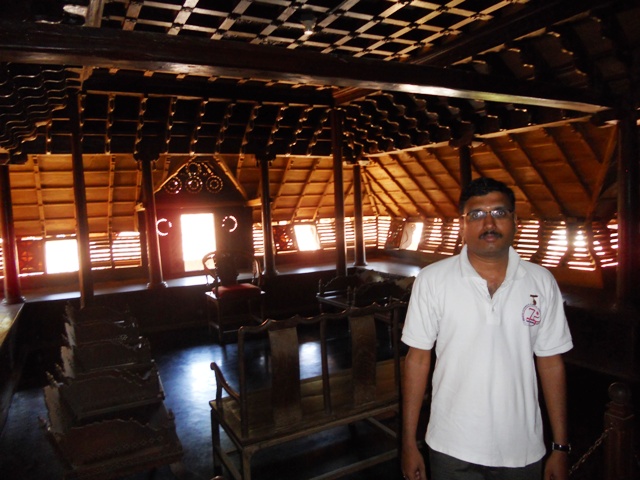
The ancient historical town Padmanabhapuram is one of the four municipalities in the district is 55 Km. south of Trivandrum, about two km. east of Thuckalay and 35 km. from Kanyakumari on the Trivandrum-Cape Comerin road.  This town is  surrounded by a fort with an area of 187 acres.  The ancient capital of Travancore might be constructed before AD 1601.  The palace with an area of seven acres, is situated in the very centre on the Padmanabhapuram Fort, amidst hills, dales and rivers.  The palace which is situated in Kanyakumari District is under the control of a Curator of the Archaeological Department of Kerala Government. 
Inside Padmanabhapuram Palace

  Entry Fee Rs 25 for Adult and Rs.10 for Children. 


Mathoor Hanging Bridge 
The  Mathoor Hanging Trough is the tallest as well as the longest trough bridge in Asia, having a height of 115 feet and a length of around one kilometre.  Constructed in 1969, this bridge has become a place of tourist importance and hundreds of tourists visit this place.  This is situated in Mathoor, hamlet of Aruvikkarai revenue village in Thiruvattar Panchayat Union. 


Mathoor Hanging Bridge

The bridge has been constructed at Mathoor across the river Parazhiyar at a cost of Rs. 12.90/- lakhs and the trough canal (Pattanamkal canal) on the bridge carries water for irrigation from one side of a hill to the other side of a hill.  The trough has a height of seven feet with a width of seven feet six inches.  The canal is being shouldered by  28 huge pillars.  

Tirparappu Water Falls  
The Kodayar makes its descend at Tirparappu and the water fall at this place is about 13km. from Pechiparai dam. 
Tirparappu Water Falls  

The river bed is rocky and about 300 feet in length.  The water falls from a height of nearly 50 feet and the water flows for about seven months in a year.  The whole bed above the falls is one rocky mass which extends up to a distance of about quarter of a kilometer upstream where the famous Thirparappu weir has been constructed for supplying water to the paddy fields.  On either side of the river, on the left bank of the river in between the water falls and the weir, there is a temple dedicated to Siva enclosed by strong fortification.   

Finally the car driver is dropped us in Nagercoil Railway station by 4.30 pm and we then travelled in Kanyakumari express to reach Chennai. Our Journey Ends...


Tuesday, October 11, 2011

Tribute to Gandhiji

On Gandhi Jayanthi Celebration at Chennai October 2, 2011,
Participated in Peace Cycle Rally conducted by Govt of Tamilnadu.


Avvayar statue Near Gandhi Statue at Morning 7.00am


Gandhi Statue after the Program


Cycle Rally Near Gandhi Statue (starting Point)


Cycle Rally At Santhome on the way to Gandhi Mandapam Adyar.


Gandhi Mandapam front view


Gandhi Mandapam - Photo Galary of Gandhiji's Life History

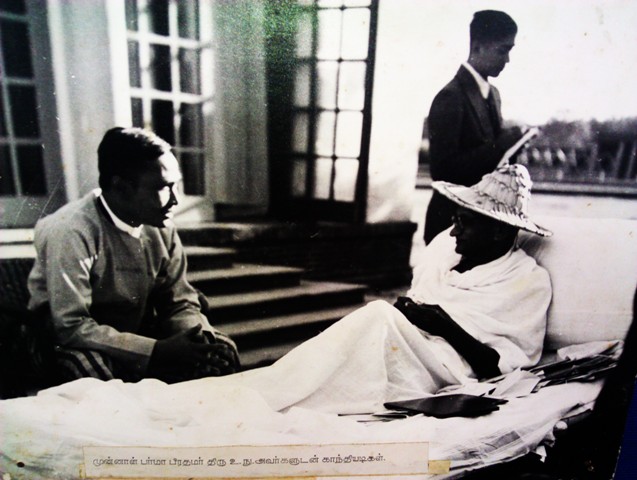
Gandhiji with former Burma PM


Gandhi Mandapam - Performing Bhajans


Sunday, September 18, 2011

Trekking To Parvatha Malai

Trekking To Parvatha Malai.

Some days before I came to know about Parvatha Malai through one of my friend. I planned to visit there and collected information about the hill. It is nearby Tiruvannamalai and Polur. From Tiruvannamalai 37km and From Polur 20 kms distance. I went to Tiruvannamalai by bus and reached by 8.00pm and had a quick darshan at Tiruvannamalai Arunachaleshwarar temple. We then boarded a Bus to Parvatha malai and get down at Thenmathi mangalam village by 10.00pm. It is said that, to climb this hill by night is best, because the climate is chill so we can’t get tired and some siddhars will cross that time. So we decided to climb by night. There are three routes are there to climb the hill. One is Thenmathi mangalam, second is mambakkam and another one is Kadaladi. Me and my friend met one friend in the bus and he guided us very well. Without him it was a tough task to us, because we are visiting first time to that place. As guided by him we taken bath in the base and started to climb by 11.30pm night and we reached the top by 3.40 am. In night torch is must for everyone. We got powerful torch so it was useful for us. In between the climbing,  rain was started and we heard a dog voice reminding us some shelter is nearby. We then climbed in that rain also and found a small shelter on the way. There we saw some dogs, somebody said if we miss the route these dogs will guide us. We saw some arrow mark showing the route also in rocks and trees to guide us in the night also. We reached by 3.40am and then performed pooja by our own (it is usual thing here) and we taken some rest. By 6.00 am we started to get down and we excited to see the paths we climbed. In night we never got feared by the way, but in the morning we saw the way was somewhat dangerous, the first few kilometres, path was  plain surface, second few kilometres steps path, third few kilometres rock path and fourth one is iron bar path- 500 feet(It is very tough). The hill is totally 4200 Hight. We then finally got down by 10.00 am. On the way to Hill some shops are there, they sell water, cool drinks, tea etc in night also. In Day time you can get light refreshments. Previously this hill was climbed only on Full moon night. Now a days every weekends, lot of peoples are climbing, even in weekdays also few peoples are climbing.


PARVATHA HILL :
Parvatham means hill and 'Parvatha Malai' as it is called is the Hill of Hills or Queen of Hills at the top of which resides the presiding deity Parvatha Rani or Parvathammal. She is the Sakthi aspect and the 'Siva' aspect is Lord Malligarjun. 'Parvathammal is also called Lordess Brahmarambika' (also called Maragathambika). It is not known when exactly the temple was constructed at the top of the hill ( about 4,000 ft. high and a difficult terrain with 'almost' vertical rocky cliff called 'Kadapparai Malai'. But pre-historic record (Malai Padu Kadaam) shows that a king called 'Maa Mannan' who was ruling that area, during the year 300 A.D used to visit this temple frequently and worship the lord and lordess. It is said that even 2000 years ago the great yogis (Siddhas) constructed this temple at the top of the hill for doing meditation.

Unlike other hills, Parvatha Malai 'Cliff' presents a wonderful sight when viewed from different angles. It portrays eight different shapes from eight directions around the hill. The view from the top of the hill is splendid and one can have a panaromic view of the landscape below (when there are no clouds) for upto even 50 kms. The sight of the rising and setting sun from the hill top is a rare one to enjoy more than that at Kanyakumari (South India). At nights visitors can witness the 'Jyothi Dharshan' at the hill top.

This virgin hill grows plenty of rare herbal plants which are not found in other hills except Himalayas. The visitors / devotees can easily smell the 'Herbal breeze' while going up or coming down the hill. It cures many diseases automatically. It is said that two 'sadhus' one guru Namasivayam and the other Guhai Namasivayam when they stayed on the hill accidentally cooked and ate an unknown herbal leaf (now known as 'Karunochi - Siddha Medicine') and regained their youth for ever.


TEMPLE in HILL:
The temple has no doors or compound wall and also no 'priests' to perform 'pujas'. The visiting devotees themselves can perform 'pujas', do 'abisheham' and 'arathanas' like in most of the North Indian temples. 'Nishta' is reached in no time when one performs 'meditation' at the top of the hill (that is the power of the 'vibration' of the hill and the presiding deities). Few devotees have experienced 'Miracles' in the hill and the temple. One has to personally experience to believe them. In many cases such 'miracles' have been encountered by few fortunate devotees when they stay overnight in the hill/ temple.


DEITIES:
The names of the presiding deities of the temple at the top of Parvatha Malai, similar to the one at 'Srisailam' temple in Andhra Pradesh (India) also has equal or more 'powers' in bestowing grace to the devotees and redressing their grievances. Milk is preferred for the pujas and there are no sacrifices offered. Oil for the temple lamp, flowers and 'Vilvam leaf' have to be taken to the top from bottom by the devotees who wish to perform pujas. Food packs, drinking water, torch light and woollen shawl also have to be taken with them.
At night times 'Jyothi' (brightness) can be witnessed on the cheeks of goddess Brahmarambika. This is a rare phenomenon in no other deities in any temple can be seen. When the devotee recede as far back from the deity, (goddess Brahmarambika) sanctum sanatorium, the size of the deity appears to increase in size instead of diminishing and is seen that the deity steps up forward and approaches towards the devotee. One has to see it to believe it ! when 'camphor is lighted up before the Lord Malligarjun and viewed from a distance while worshipping, the images of serpent, trident and drum appears in the camphor light. When a devotee 'Chants' 'OM' mantra sincerely 108 times before the Lord Malligarjun in the 'Sanctum sanatorium', he/she can clearly hear 'Silent whisper' of 'OM' mantra from behind.


IMMORTAL YOGIS (SIDDHARS):
It is believed that several 'siddhars' still live in small natural caves all along Parvatha Mallai hill and they give 'dharshan' to few lucky visitors / devotees. Since they move in 'subtle bodies' it will be difficult to have their 'dharshan' with the naked eye. Only with the power of the 'third eye' (Gnanakkan) any sincere devotee can at times witness the presence of siddhars. These siddhars often take on mortal (gross) bodies to facilitate viewing them e.g., in the form of vegetation, birds animals and very rarely human form also. Sometimes devotees though unable to see them in physical form spot them out on the hill from the smell of fragrance' like camphor, agarpathi, or sambrani which the siddhars carry around them. At times , it is a rare sight to have 'dharshan' of 3 'kazhugus' making rounds over the cliff of Parvatha Malai just like one can witness 2 kazhugus over 'Thirukkazhukundrum' hill top. These kazhugus are believed to be 'siddhars' giving 'dharshan' to the devotees taking on the form of birds; some times siddhars give dharshan to sincere devotees in the form of 'honey bee, bairavar (dog), etc. and guides them the path while trekking up the hill or stepping down.


It is believed that these 'siddhars' visit the temple on the top of 'Parvatha Malai' at 12 0' clock midnight to worship the presiding deities there. Though no one can or have seen them in physical bodies, villagers around the 'Parvatha Malai' down below say that they can clearly hear the sound of ringing bells, blowing conch, drums beating etc., exactly at 12 mid night when the 'pujas' are performed by siddhars.


TREKKING THE HILL:
There are three places from where the 'peak' of Parvatha Malai can be accessed. One is from a place called 'Then madhi mangalam' the second from Mambakkam and the third from Kadaladi. Normally the first and the last routes are chosen as the second one is very steep and difficult to climb. Out of the first and the last, the first route is comparatively easy to climb as half of the trekking distance (12 km) is mostly plains and the rest is also not very steep. Most of the visitors / devotees take the first route to climb and while trekking down, prefer the Kadaladi route more so since the setting up of the 'Ashram' at Kadaladi region. The first route takes about 4 hours to climb while the last one, only 3 hours to climb. On full moon / new moon and important days all along the trekking route, the visitors find small temporary shops where they can take rest for a while and refresh themselves with drinking water (available in packets), tea, coffee, biscuits etc.,

One has to trek through 6 small hills to reach the top of 'Parvatha Malai' which is the seventh. It is said to be synonymous to the 6 'Chakras' in the human subtle body. The Mooladhara chakra or Kundalini climbs up and after crossing six other Chackras, joins with the seventh 'Sadasivam' or Sahasradhara chakra. About 3/4 of the hill route is through thick forest via treaded foot path where on both sides one can enjoy the smell of 'Himalaya's rare herbs' are in plenty. The last 1/4 portion of the trek is a bit difficult to climb as the path is rocky and almost vertical. It is called 'Kadapparai Malai' since there are no regular steps to climb and only with the help of 'Iron rods' which are embedded in the solid rock, one has to climb keeping his steps alternately on the notches carved on the rock.


The trekking of this last portion is almost like in mountaineering and as such one has to come prepared with 'kits' similar to mountaineering. Shorts are preferred to wear and the kit containing drinking water, puja materials, fruits, biscuits and other eatables should be carried on the back as both the hands should be free to grip the Kadapparai one after the other.

There are no wild animals or any poisonous insects on the way and people of any age can climb up the hill with 'will power'. So far in the history of Parvatha Malai, there is no record of any visitors / devotees falling down and meeting with death. Though after trekking the Parvatha malai route on the hill, legs pain for atleast 2 days


LOCATION and ACCESS TO PARVATHA MALAI

This wonder hill is situated in Kadaladi P.O., Thiruvannamalai Dist. Tamilnadu (India). It is about 37 km North West of Thiruvannamalai. Thiruvannamalai is well connected by rail and road from all major towns & cities in Tamilnadu. Kadaladi can be accessed from Thiruvannamalai only by road. Buses are plying regularly to and from Thiruvannamalai main bus stand. Kadaladi can also be reached by private cars, vans and auto etc. from Thiruvannamalai, which takes about 45 minutes. As earlier stated Parvatha Malai can also be climbed from Then-madhi mangalam or Mambakkam, which are near to Kadaladi.  Polur is 20 km from thenmathimangalam.


Visit my Tamil Blog: http://iniyaindiyavilravi.blogspot.in/2012/10/blog-post.html
Visit my Hindi Blog: http://merabharatmahan-mountabu.blogspot.in/