Tuesday, April 19, 2011

Jodhpur - The Sun City

One of my friend is working in CRPF was deputed to Jodhpur and he invited me to visit Jodhpur. On my Mount Abu Trip, I palnned to visit one day to Jodhpur. I started in the night from Mount Abu by 10.00pm to catch a 11.45 pm train to Jodhpur. I reached earlier to the station, I am waiting for the train with unreserved ticket. The train reached Abu Road by 11.50pm and I boarded the train and somehow managed to get one seat. But the train scheduled to departure was 12.05 was not departed due to Engine problem. I was feeling very sleepy but I couldn't sleep due to take care of my belongings as this was a unreserved coach. Fianlly after fault rectification train was started by 2.45 am and reached Jodhpur by 7.15 am. My friend was waiting in the station to receive me, otherwise it will be very difficult to reach his camp. We boarded a auto and reached Mandore(King Ravana's wife-Mandothari's birthplace) nearby his camp and walked few kms to reach his camp. We saw a monument where Ravana and Madothari's wedding ceremony was performed. 


After reached his camp, refreshed in his room and had breakfast. He has office that day(He was working as ASI in CRPF), so waited for him to finish his work. After 11.0 he was free he arranged a CRPF van for us to roam around the city. Two guards with AK47 are guarded us in the van, make proud of my Friend Shibukumar. We visited  Mehrangarh Fort and Umaid Bhavan and parks. All the places my friend was not charged the entry fees are they reduced the fees. we reached again to our camp for lunch as he was having some work. Also I was feeling sleepy, because I was not slept in the train. So I finished my lunch and slept for some time. In the evening I have to catch my train to Abu Road for my connecting train, So we started early by 5.00 pm and reached the station. My friend again travelled with me to the station to send off me. I boarded the 6.30 pm Suryanagari Exp, which is my train from Abu Road to reach Ahmedabad. I thanked my friend Shibukumar for the Wonderful trip and hospitality during my visit to Jodhpur. 

About Jodhpur

Jodhpur gets its name from its founder, Rao Jodha, the Rathode chief. The Rathodes are believed to belong to the dynasty of the sun god himself (Surya Vamsha) which has produced great persons such as Lord Rama and King Harish chandra. It is believed that the city came into being in 1459 A.D. Jodhpur has been an important trading centre of Rajasthan even in ancient times and is currently the second largest city of the state.

Jodhpur boasts of an airport, located at mere 5 km from the heart of the city. Regular flights connect Jodhpur airport with the major cities of India such as Jaipur, Mumbai, Kolkata and Delhi. Jodhpur is also a major railway junction and is well connected by the Indian Railways network to the rest of the state and country. A good number of RSTC buses and private luxury buses ply between Jodhpur and places such as Jaipur, Jaisalmer and Delhi.

A number of festivals and fairs such as Nag Panchami (August-September), Marwar Festival (October), Nav Sati, Veerpuri Fair (July-August), Gangaur, Holi (March) and Diwali (Oct-Nov) are celebrated in the town amidst much gaiety and cheer. Vendors set up small shops on either sides of the street. A range of colourful fabrics, textile and dresses are put up on display. Ghagras embroidered with multi hue threads, sequins and mirrors, block printed durries, bandhini sarees, chunky tribal and silver jewellery, brass artefacts and colourful glass and lac bangles are on display. To commemorate the Marwar or the Maand Festival a number of events such as horse riding and polo are organized. Folk music and dance recitals are held all over the city. Kacchi Ghoodi and Jhoomar are the favourites for these festive celebrations. The city is the hub of a flourishing handicraft industry. The teeming bazaars and the attractive sweet shops are almost irresistible. The historic fort and the quaint charm of the old city make Jodhpur a tourist paradise.

Places to see


1. Mehrangarh Fort

Situated on a huge hill, Mehrangarh fort is one of the largest forts in India . The beauty and the grandeur of numerous palaces in the fort narrates a saga of hard sandstones yielding to the chisels of skilled Jodhpuri sculptures. Mehrangarh Fort, spreading over 5 km on a perpendicular hill and looking down 125 meters, presents a majestic view on city horizon.

It was built on advice of a saint in 1459 to establish an impregnable head-quarter. This Fort is one of the best in India with its exquisitely latticed windows, carved panels, elaborately adorned windows and walls of Moti Mahal, Phool Mahal, Sheesh Mahal. A collection of musical instruments, palanquins, royal costumes, furniture and the cannons on the fort's ramparts are well preserved. Entry fees. Rs. 40 per person.


2. Jaswant Thada

Close to the fort complex, lies Jaswant Thada. This 19th century royal cenotaph built in white marble in commemoration of Maharaja Jaswant Singh II and three other cenotaphs, stand nearby. The cenotaph of Maharaja Jaswant Singh holds the rare portraits of the rulers and Maharajas of Jodhpur . A visit inside the cenotaphs, with some villagers of the region, would bring forward the reverence they still hold for their brave kings

3. Umaid Bhawan Palace

The romantic looking Umaid Bhawan Palace was actually built with the purpose of giving employment to the people of Jodhpur during a long drawn famine. The royal family of Jodhpur still lives in a part of the palace. Another part of the palace houses a well-maintained museum, displaying an amazing array of items belonging to the Maharaja and the royal family - weapons, antiques & fascinating clocks, crockery and trophies. Entry fees. Rs. 30 per person.

4. Government Museum

This museum has a rich collection of weapons, textiles, miniature portraits, local crafts and images of Jain Tirthankars. It is situated in the middle of the Umaid public gardens.

5. Rai-ka-Bag Palace

This palace is situated near Raika Bag palace railway station. It was constructed in 1663 by Hadiji, queen of king Jaswant Singh-I. King Jaswant Singh-II liked this palace very much. He mostly stayed in the octagonal bungalow of this palace. In 1883 when Swami Dayanand Saraswati came to Jodhpur , his sermons were arranged for the public in the public ground of this palace. Even Jaswant Singh used to listen to Swami Dayanand in this palace only. Now income tax office functions in this palace.

6. Umaid Garden

Umaid garden covers an area of 82 acres, developed by Maharaja Umaid Singh, it has green lawns, towering Ashoka trees, roses and seasonal flowers, museum, fountains, library and a zoo. In 1978 'Walk-in Aviary' was constructed there one could see different types of birds, local, African and Australian parrots, ducks, rabbits etc; in their natural environment. There are large cages for bears, foxes, deer, lions leopard etc. This place was frequently visited by children and adults with equal interest.

7. Raja Ranchodji Temple

It was made by queen Jadechi Rajkanwar after the death of her husband, king Jaswant Singh. Major Part of the temple is made of red sandstone, carved with beautiful filigree work. The heart of the temple has the statue of Ranchodji made of black marble. It has green, yellow and blue glasses fixed on its main door.

8. Achal Nath Shivalaya

Achal Nath Shivalaya was constructed by Nanak Devi, queen of Rao Ganga. The construction was completed on 21st May 1531. A large water reservoir called Bawari was made near the Shivlinga which is known as Ganga Bawari. The Garbh Griha, Mandap and Kirtan Bhawan of the temple are made of carved Chitar stone.

9. Siddhnath

Siddhnath Shiv temple is located between Takhat Sagar hills. On the road going from the right of filter house on Jodhpur-Chopasani Road , on crossing the stairs made by cutting rocks, one can reach Siddhnath temple. Many years ago it was an absolutely deserted place. And because of that, a hermit Veetragi Narain Swami started staying here. He was a highly worshipped and respected saint, known in the nearby areas. Once a handicapped saint named Gauri shankar, later known as Nepali Baba, came to this place. He had only four fingers in each of his hand and foot. He made a big temple by cutting stones, which is now known as Siddhnath.

10. Ganesh Temple

The area which is called Ratanada was named after a dog called Rata. About 150 years ago a teacher Radidas in a place called Gorunda saw a statue of Vinayakji in the hills of Ratanada. The statue is eight feet high and five feet wide.

Around Jodhpur

Mandore

Towards the north of Jodhpur is the ancient capital of Marwar, Mandore is situated just 8 Kms from the city. Main attractions of the place are hall of Heroes where sixteen huge figures which have been carved out of a single rock, the shrine of 330 million Gods and the royal cenotaphs. This area is of immense historical importance but what makes it worthy of a visit is the Hall of Heroes. Sixteen gigantic figures carved out of a single rock depicting popular Hindu and folk deities stand there in bright colours and are well maintained. But one can not miss the caves in crags and the sprawling gardens, which are now shelter place for monkeys and peacocks. Greenery of the place makes Mandore, in true sense, an oasis.


Ossian

65 Kms from Jodhpur , lies ruins of an ancient city called Ossian. This city is famous for Brahmanical and Jain temples, which belong to 8th and 11th century. Surya or Sun temple and the Sachiya temples are famous for their beauty. The shikhar of Sachiya temple is clustered by two rows of turrets, an ambulatory and a large assembly hall with an elaborate ceiling. This town which was once a great trading centre is an oasis and houses an abundance of peacocks. The largest of the 16 Jain and Brahmanical temples is dedicated to Mahavira, the last of the Jain tirthankars. In the same area the Surya temple has fascinating images of Durga, Surya and Ganesh. The sculptural intricacy of the Osian temples rival that of any of the famous temples of the country, be it the Sun Temple of Konark, or the Hoysala temples of Karnataka.

Balsammand Lake & Palace

Many a times you must have dreamt of staying in a huge, royal palace on the sea-shore or on the banks of river or if not both at least a palace facing the water reservoir. There is such a place at Mandore in Rajasthan. The 19th Century sandstone palace built on a hillock facing Balsammand lake is one of such places that's definitely going to win your heart.
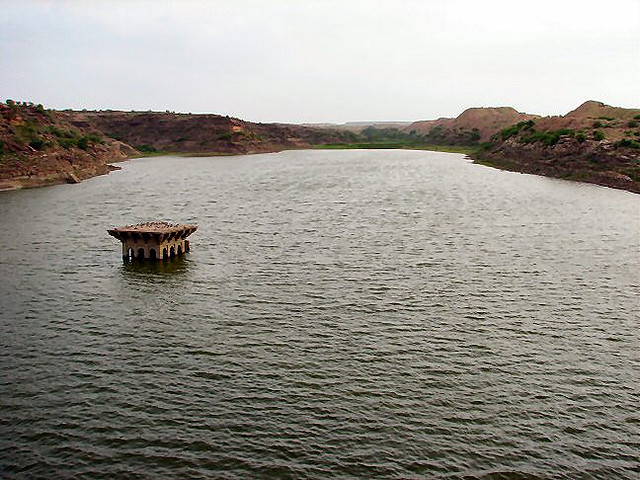


The palace was created by Maharajah Sur Singhji, as a summer pavilion. It is very finely carved with latticed windows that allow the soft, cool breeze to blow into the interiors of the palace. The embankments of the lake, in front of the palace, have domed structure that offers fabulous views of the lake encircled by hills. An artificial cascading waterfall, brings water down from the reservoir to the gardens. Mandore, is a part of Jodhpur but it enjoys the calmness by being far from the city crowd.one feel as if you are staying in a royal palace. One can even enjoy a walk through the trees, the rose beds, pools covered with lilies and the groves of mango, plum, banana, pomegranate and so on. One will also get to see the peacocks, blue bulls, jackals and hundreds of flying foxes (fruit bats) in the trees.

Kaylana Lake.  Located 8 kms. West of Jodhpur, Kaylana lake was constructed in 1872 by Pratap Singh. It is spread over 84 square kilometers' area. Earlier this area had palaces and gardens made by two rulers of Jodhpur-Bhim Singh and Takhat Singh. These were destroyed to make Kaylana lake. Near the lake is a Dak Bungalow of PHED. Boating facilities have also been made available for tourists here.


Guda Bishnoi This village is inhabited by the Bishnoi community. They are staunch believers in the sanctity of plant and animal life. Villages are marked by Khejri trees and deer which thrive. Jaswant Sagar Dam In 1892, Maharaja Jaswant Singh constructed Jaswant Sagar in Pichiyak village between Bilara and Bhavi of Jodhpur district.The Water from this dam is used for irrigating the greenest part of Jodhpur receives water from this dam. Boating facilities have also been made available for tourists here..

Where to Stay

The variety of hotels and guest houses in Jodhpur makes one feel at home. Accomodation here is available to suit tourists of every budget. Hotel Karni Bhawan, Ajit Bhawan are heritage hotels. Rajasthan tourist department has the Ghoomar hotel. The palace hotels as the Umaid Bhawan Palace, Ratanada Polo Palace, Taj Heri Palace, Rajputana Palace . Raj Basera also provides us with good accommodation facilities. There are low budget accommodation too.

Where to Eat

Delicious Sweets : Jodhpur is famous for its sweets. One can find a large crowd at every shop of sweet delicacies. Its in tradition of jodhpur that first you have to eat sweet and then start other food. One can't escape from sweet hospitality ("Mithi Manuhar") of Jodhpur and than quite appropriate that this is the secret of the sugary tone of the citizen of this city. 'Mave ki Kachori' , 'Besan ki Chaaki', 'Maakhan Vade' are some of the most famous sweets of Jodhpur. Janta Sweet Home, Jodhpur Sweet Home", Pokhar Sweets are some of the shop where one can find a quality and variety of sweets.

Where to Shop

Jodhpur is famous now, all over the world for handicrafts in wood, iron and camel bone.There are a lot of fabric shops, selling 'bandhini' (very fine tie & dye), hand block prints, silver shops selling jewellery by weight, and antique shops.

The Sadar Market near the clock tower gives immense shopping pleasure to the local as well as the visitors.

The colourful but hectic bazaar consists of many narrow lanes, lined with tiny shops. Look for the tie & dye textiles, embroidered leather shoes, lacquer ware, antiques, carpets and puppets. Here one can buy exquisite Rajasthani textiles, clay figurines, miniature camels and elephants, marble inlay work and classic silver jewellery.

Most Popular Items of Jodhpur

Antiques

Bandhini sarees

Footwear

Mathaniya's Red Chilli

Jodhpur is a veritable shopper's paradise. There are so many markets to fulfil your thrust of shopping viz. Tripolia bazaar, Sarafa bazar, Sardarpura Market, Sojati Gate, National Handloom is most popular departmental shop where one will find all types of accessories and cloths situated in Nai Sarak and if you are tired with shopping take Jodhpur speciality- Mirchi bada and some sweets available near this shop. Jodhpur is home to many talented and skilled craftsmen like textile dyers, metal engravers and'die-makers, and probably the last of the tailors of the classic ' Jodhpur ' breeches. Specially Jodhpuri suit gives you a royal identity to your dressing.

How to get there

Air

The airport is 5km from city centre. The Indian Airlines Office is south of the Centre on Airport Road and is open daily from 10 am to 1pm and 2 pm to 4.30 pm. It has flights from Delhi, Mumbai, Udaipur and Jaipur.

Rail

The city is well connected by the railway lines and trains are available from all major cities in the country for here. The booking office is on Station Road, between the railway station and Sojati Gate. The office is open from Monday to Saturday from 8 am to s pm and only until 1.45 pm on Sunday.

Road

RSTC buses and private luxury buses connect Jodhpur with almost all major places of Rajasthan and Delhi.

Local Transport

Means of transport in Jodhpur include Taxis, Auto-rickshaws, Tongas. Taxi stand is near the main railway station. Auto-rickshaws are best suited for traversing the narrow lanes of the old city. Jodhpur is a good place to explore by bicycle.


Monday, April 18, 2011

AGRA - The Mahal

AGRA – The Mughal's Era.

Agra is a city on the banks of the Yamuna River in Uttar Pradesh. It is located at the distance of 363 kilometres west of UttarPradesh capital, Lucknow and 200 kilometres south from India capital New Delhi. It is 20th most polluted city in India, Because 80 percent of the city's sewage flows into Yamuna River.


The city finds mention in the Mahabharatha epic, where it was called Agrevana or 'the border of the forest'. Legend ascribes the founding of the city to Raja Badal Singh (around 1475), whose fort, Badalgarh, stood on or near the site of the present Fort. It is generally accepted that Sultan Sikander Lodi, the Ruler of the Delhi sultanate founded Agra in the year 1504. After the Sultan's death the city passed on to his son Sultan Ibrahim Lodi. He ruled his Sultanate from Agra until he fell fighting to Babar in the Ist battle of Panipat fought in 1526.
Agra Fort Entrance


In the year 1556, the great Hindu warrior Hemu Vikramaditya, also known as Samrat Hem Chander Vikramaditya, won Agra as the Prime Minister cum Chief of Army of Adhil Shah of the Afghan Suri Dynasty.

The golden age of the city began with the Mughals. It was known then as Akbarabad and remained the capital of the Mughal Empire under the Emperors Akbar, Jahangir and Shah Jahan. Shah Jahan later shifted his capital to Shajahanabad in the year 1649.

Since Akbarabad was one of the most important cities in India under the Mughals, it witnessed a lot of building activity. Babar, the founder of the Mughal dynasty, laid out the first formal Persian garden on the banks of river Yamuna. The garden is called the Aram Bagh or the Garden of Relaxation. His grandson Akbar raised the towering ramparts of the Great Red Fort, besides making Agra a center for learning, arts, commerce and religion. Akbar also built a new city on the outskirts of Akbarabad called Fatehpur Sikri. This city was built in the form of a Mughal military camp in stone.

His son Jahangir had a love of gardens and flora and fauna and laid many gardens inside the Red Fort or Lāl Qil'a. Shah Jahan, known for his keen interest in architecture, gave Akbarabad its most prized monument, the Taj Mahal. Built in loving memory of his wife Mumtaj Mahal, the mausoleum was completed in 1653.

Shah Jahan later shifted the capital to Delhi during his reign, but his son Aurangazeb moved the capital back to Akbarabad, usurping his father and imprisoning him in the Fort there. Akbarabad remained the capital of India during the rule of Aurangazeb until he shifted it to Aurangabad in the Deccan in 1653. After the decline of the Mughal Empire, the city came under the influence of Marathas and Jats and was called Agra, before falling into the hands of the British Raj in 1803.

Taj Mahal

Taj Mahal is one of the most famous buildings in the world, It is one of the New Seven Wonders of the world, and one of three World Heritage Sites in Agra. In 1983, the Taj Mahal became a UNESCO World Heritage Site. It is widely considered as one of the most beautiful buildings in the world and stands as a symbol of eternal love.


Tajmahal without pillars

Taj Pillar

Taj Mahal was built by the Mughal king Shah Jahan as the final resting place for his beloved wife, Mumtaz Mahal. Finished in marble, it is perhaps India's most fascinating and beautiful monument. This perfectly symmetrical monument took 22 years (1630–1652 - Completed in 1653) of labour and 20,000 workers, masons and jewellers to build and is set amidst landscaped gardens. Built by the Persian architect, Ustād Isa, the Taj Mahal is on the bank of the Yamuna River. It can be observed from Agra Fort from where Emperor Shah Jahan gazed at it, for the last eight years of his life, a prisoner of his son Aurangazeb. It is an acknowledged masterpiece of symmetry. Verses of the Kuran are inscribed on it and at the top of the gate are twenty-two small domes, signifying the number of years the monument took to build. The Taj Mahal was built on a marble platform that stands above a sandstone one. The most elegant dome of the Taj Mahal has a diameter of 60 feet (18 m), and rises to a height of 80 feet (24 m); directly under this dome is the tomb of Mumtaz Mahal. Shah Jahan's tomb was erected next to hers by his son Aurangzeb. The interiors are decorated by fine inlay work, incorporating semi-precious stones.


Taj Mahal Design Work

Outlying buildings of Tajmahal - The Taj Mahal complex is bounded on three sides by crenellated red sandstone walls, with the river-facing side left open. Outside the walls are several additional mausoleums, including those of Shah Jahan's other wives, and a larger tomb for Mumtaz's favorite servant. These structures, composed primarily of red sandstone, are typical of the smaller Mughal tombs of the era. The garden-facing inner sides of the wall are fronted by columned arcades, a feature typical of Hindu temples which was later incorporated into Mughal mosques. The wall is interspersed with domed chattris, and small buildings that may have been viewing areas or watch towers like the Music House, which is now used as a museum.
The Main Gateway view from Taj

The main gateway (darwaza) is a monumental structure built primarily of marble which is reminiscent of Mughal architecture of earlier emperors. Its archways mirror the shape of tomb's archways, and its pishtaq arches incorporate the calligraphy that decorates the tomb. It utilizes bas-relief and pietra dura inlaid decorations with floral motifs. The vaulted ceilings and walls have elaborate geometric designs, like those found in the other sandstone buildings of the complex.

Mosque in Tajmahal Campus
Taj Mahal mosque - At the far end of the complex, there are two grand red sandstone buildings that are open to the sides of the tomb. Their backs parallel the western and eastern walls, and the two buildings are precise mirror images of each other. The western building is a mosque and the other is the jawab (answer), whose primary purpose was architectural balance, although it may have been used as a guesthouse.

Side View of TajMahal
Controversies - A longstanding myth holds that Shah Jahan planned a mausoleum to be built in black marble across the Yamuna River. It was suggested that Shah Jahan was overthrown by his son Aurangzeb before it could be built. Ruins of blackened marble across the river in Moonlight Garden, Mahtab Bagh, seemed to support this legend. However, excavations carried out in the 1990s found that they were discolored white stones that had turned black. A more credible theory for the origins of the black mausoleum was demonstrated in 2006 by archeologists who reconstructed part of the pool in the Moonlight Garden. A dark reflection of the white mausoleum could clearly be seen, befitting Shah Jahan's obsession with symmetry and the positioning of the pool itself.

In 2000, India's Supreme Court dismissed P. N. Oak's petition to declare that a Hindu king built the Taj Mahal. Oak claimed that origins of the Taj, together with other historic structures in the country currently ascribed to Muslim sultans pre-date Muslim rule of India and thus, have a Hindu origin.

Taj Mahal is at a distance of 6 km. from Agra Contonment Railway station.

Open for Public view from 6 a.m. to 7 p.m. on weekdays, except for Friday when the complex is open for prayers at the mosque between 12 p.m. and 2 p.m. The complex is open for night viewing on the day of the full moon and two days before and after, excluding Fridays and the month of Ramzan. For security reasons only five items - water in transparent bottles, small video cameras, still cameras, mobile phones and small ladies purses are allowed inside the Taj Mahal

Agra Fort

Agra Fort also called Agra's Red Fort, was commissioned by the great Mughal Emperor Akbar in 1565, and is another of Agra's World Heritage Sites. A stone tablet at the gate of the Fort states that it had been built before 1000 but was later renovated by Akbar. The red sandstone fort was converted into a palace during Shāh Jahān's time, and reworked extensively with marble and pietra dura inlay. Notable buildings in the fort include the Pearl Mosque, the Dīwān-e-'Ām and Dīwān-e-Khās (halls of public and private audience), Jahāngīr's Palace, Khās Mahal, Shīsh Mahal (mirrored palace), and the Musamman Burj.

Fort Inside View

The great Mughal Emperor Akbar commissioned the construction of the Agra Fort in 1565, although it was converted into a palace by his grandson Shāh Jahān, being reworked extensively with marble and pietra dura inlay. Notable buildings in the fort include the Pearl Mosque or Motī Masjid, the Dīwān-e-'Ām and Dīwān-e-Khās (halls of public and private audience), Jahāngīr's Palace, Khās Mahal, Shīsh Mahal (mirrored palace), and the Musamman Burj. The forbidding exteriors of this fort conceal an inner paradise. The fort is crescent shaped, flattened on the east with a long, nearly straight wall facing the river. It has a total perimeter of 2.4 kilometers, and is ringed by double castellated ramparts of red sandstone punctuated at regular intervals by bastions. A 9 meters (30 ft) wide and 10 meters (33 ft) deep moat surrounds the outer wall.

Chhatrapati Shīvajī visited the Agra Fort, as a result of the conditions of the Treaty of Purandar entered into with Mirzā Rājā Jaisingh to meet Aurangzeb in the Dīwān-i-Khās (Special Audience Chamber). In the audience he was deliberately placed behind men of lower rank. An insulted Shīvajī stormed out of the imperial audience and was confined to Jai Sing's quarters on 12 May 1666. Fearing the dungeons and execution he escaped on 17 August 1666. A heroic equestrian statue of Shīvajī has been erected outside the fort.

The fort is a typical example of Mughal architecture, effectively showing how the North Indian style of fort construction differentiated from that of the South. In the South, the majority forts were built on the seabed like the one at Bekal in Kerala.

Fatehpūr Sikrī


Fatehpur Sikri is located at a distance of about 39 K.M. from Agra. Fatehpur Sikri is an epic in red sandstone. A city of yesteryear today lost in the mists of time. Fatehpur Sikri was built by the Mughal Emperor Akbar during 1564 A.D. Mughal Emperor Akbar had no heir. He visited holy men to enlist their prayers for his son. When he visited Sheikh Salim Chishti who was living at the village of Sikri the saint foretold the emperor that he would be blessed with a son. When is son was born, he is gratitude, constructed his capital city and named it Fatehpur Sikri. Later, due to shortage of water and unrest in North-West, Akbar has to abandon this city. The beautiful marvel tomb of Sheikh Salim Chishti still attracts thousands who seek blessings of the revered saint. Other renowned places are Dewane-e-Am, Dewane-e-Khaas, Buland Darwaja, Panch Mahal, Jodha Bai Palace and Birbal Bhawan.

Fatehpur Sikri

 Buland Darwāza or 'the lofty gateway' was built by the great Mughal emperor, Akbar in 1601 at Fatehpūr Sikrī. Akbar built the Buland Darwāza to commemorate his victory over Gujarat. The Buland Darwāza is approached by 52 steps. The Buland Darwāza is 53.63 m high and 35 meters wide. It is made of red and buff sandstone, decorated by carving and black and white marble inlays. An inscription on the central face of the Buland Darwāza demonstrates Akbar's religious broadmindedness; it is a message from Jesus advising his followers not to consider this world as their permanent home.

Akbar's Tomb, Sikandra

Sikandra, the last resting place of the Mughal Emperor Akbar the Great, is on the Delhi-Agra Highway, only 13 kilometres from the Agra Fort. Akbar's tomb reflects the completeness of his personality. The vast, beautifully carved, red-ochre sandstone tomb with deers, rabbits and langurs is set amidst a lush garden. Akbar himself planned his own tomb and selected a suitable site for it. To construct a tomb in one's lifetime was a Turkic custom which the Mughals followed religiously. Akbar's son Jahāngīr completed construction of this pyramidal tomb in 1613. The 99 names of Allah have been inscribed on the tomb.
Akbar's Tomb

About My Visit to Agra-

Agra is a beautiful place as Tajmahal and Agra fort is there, otherwise it is a much polluted city. I've been there for 6 times. Almost every year from 2006 I'll go to Agra on the way to Delhi.

Agra Fort inside ticket entry
We start from Chenai by Tamilnadu express and reach Agra by 3.45 am on the next day. We refresh in one of the hotels nearby or in the Railway Waiting Hall. First we take a breakfast and move to our first place Agra Fort. The entry ticket for this Rs.10/- (cameras are allowed). You can see the big Fort with gardens and the architecture of the building. Shah jahan's jail, Aurangazeb's Hall and Shah jahan's Durbar also the distance view of Tajmahal are the must see places. There are lots of cameramen and guides will surround you for the photographs and guiding. The cameramen charge Rs.30 per photo and require 30 minutes. After giving you the photo you can give the money. The guide will explain you for Rs.50 - 100/- (approx). It will take minimum 2 hours to see the entire fort. If you have time in leisure you can be there for half a day that much of places are there to see.


Yamuna River Backside of TajMahal


Camel Ride

After that we went to Taj Mahal, one of the Seven Wonders of the World. All the fuel vehicles are stopped 1 KM before of Tajmahal, because of pollution and for the care of Tajmahal. The shining of the Tajmahal is reducing by the fuel pollution. But you can take a Battery car or a Camel Cart for reaching near to Tajmahal. They are charging Rs.5 per person. (latest March 2011 rate) Somebody will cheat you and ask Rs.20 or Rs.10 per person. So be careful. The entry ticket for Tajmahal is Rs.20 per person for Indians. Mobiles, Digital cameras and small video cameras are allowed. But food stuffs, Big Video Cameras and other electronic items are not allowed inside. Be remember don't go on Sunday to Tajmahal, because there will be a huge crowd for entry ticket and for entry. Your time will be wasted more than 2 to 3 hours by the crowd. Also don't go on Friday, it's closed for visitors on Friday.
Tajmahal view from Agra Fort

Slippers and shoes are not allowed inside the main Taj Complex, because the marble floor get scratched or spoiled. There is a stand for slippers and shoes to be taken care freely. If you want to give any money to the caretakers you can give them, not compulsory. The main white Marble building is the main attraction. In this building the coffin of the Mumtaj and Shah jahan was there in underground. The public are not allowed inside the underground. A replica of the coffins was made for public view on the Main floor under the Big dome.

Original Shajahan and Mumtaj's Tomb
Some people are throwing coins to the underground steps leading to the Original coffins. Somebody told the Tajmahal is the Hindu temple God Siva's TejoMahalaya and later occupied by the Mughals and converted it to a Cemetery. The suspect was grown as we see some of the other steps are leading to the underground / basement of Tajmahal was locked and sealed. As per the diagram of Tajmahal, in the basement there are lots of rooms. Some belief is there, these rooms consists of the remaining of Hindu Temple, that's why the Rooms are locked and certain parts of the Tajmahal is restricted by Public.

We taken lot of photographs separately and in group in different places inside the Tajmahal. We left the Tajmahal with the memories.

We then went to Akbar Tomb on the way to Mathura. It was built for the King Akbar planned by him. 99 names of Allah is carved on the Tomb is the speciality of this Tomb. A Big lush Green garden is welcoming you to this Tomb.

In the Surroundings of Agra, you can visit Fatepur sikri at a distance of 39km and you can also visit Bharatpur Bird Sanctuary at a distance of 50km and Mathura is 60 km from Agra.


We then moved to our next place Mathura by Bus.

Monday, April 4, 2011

Haridwar - The Way of Ganga

I was in the Haridwar recently and it was seen everywhere the clear Ganga Water - River.  
We dipped the holy water and seen lot of temples and enjoyed a lot. My experience in Haridwar during my visit is explained here with some photos taken by me. Hope you will also enjoy this...

First we started on 7th March 2011 from Delhi by Mussoorie express @10.00 pm and reached Haridwar around 7.00 am next day 8th March 2011. On the train itself we met one old man, he knows everything about Haridwar and Rishikesh. He is a regular visitor it seems. With the information gathered from him and have some information from web we proceed to Haridwar.


Ganga River

Sankar Statue in Haridwar


Rope Car to Mansa Devi Temple

First we moved to a Iyappa Temple cottages nearby the Railway station. There are plenty of Share autos are there. They charged Rs.10 per passenger to this Temple. The rooms provided to us is in a Ok Condition and they charged Rs.300 per day for 4 persons. (I think they charged us more as we are new to haridwar). In front of a Temple cottage, some of the Auto drivers are waiting for local tour and they approached us immediately when we arrived to temple. Then we finalised for a local Haridwar trip including morning ganga bath and upto evening Ganga Arathi Rs.800/- (This autos can accomodate 10 persons easily - but we are only 6, anyhow we have to pay Rs.800 for this auto). The auto driver was very pleasing and helpful to us. He first taken us to the Ganga for bathing. There are lot of places are for bathing - named ghats. like birla ghat, sivananda ghat, bramha gund etc., we taken bath in the Birla Ghat. The water was clear and moving with some speed. @ 9 am also the water was very chilled and the steps are slippy. Somebody said don't use soap to bath, it is banned there. We taken bath with cautious. We saw there some peoples are offering flowers with deepam and coconut to ganga matha. Then we left to our room and for breakfast by the same auto.


After finishing breakfast, first we went to Mansa Devi Temple, it can be reachable by Rope car (They charging Rs.48/- per person) and by steap road. We opted for Rope car and take darshan of a Mansa Devi Mandir. There is one more temple here in Haridwar accessible by Rope car is Chandi Devi Temple ( Rope car Charges Rs.80 approx). We have left this because we don't have time and as suggested by the old man met in the train. Then we saw Sankaracharya matt, Geetha Temple, Parad Sivaling at Kankhal.

Parad (Mercury) Sivaling


We also went to Dakshaneswar temple, where the Daksha maharaj made yagna and his duaghter godess parvathi came to quarell for not calling sivasankar for the yagna.


Dakshaneshwar Temple


Lord Dakshaneshwar
After Luch we went to some artificial temple in Haridwar. Some Electronic Temples, Pawan Cham Glass Temple, Char dham temple and Bharat matha mandir. In these Pawan dham Glass temple is worth seeing and free entry. The electronic temples and artificial temples made in these area are money minded. Some of the pandits in these temples are asking us to lean to them, they will put thilak in our fore head and pat on our backside and ask us for a dakshana. I don't like these kind of activities in temples. Finally we saw Bharat matha mandir, it is a 7 storey building having lift (charging Re.1/- per person). they will take us to the 7th floor, there from the 7th floor we have to come down by walk and see in each floor the idols of national leaders, sadhus, sanths and devthas.


Electronic Temple
                                                   

Pawan Dham Glass Temple

Radha Krishna at Glass Temple

Uma Shankar at Glass Temple

                                                      
Char Dham Mandir

                                                              
Bharath Matha Mandir

In the evening, we went to Har ki pauri and waited for the famous Ganga Arathi. By 6 pm the people are gathering slowly and by 6.30 the Har ki pauri was fully packed with peoples all along the ganga river steps. After 6.30 pm the Ganga arathi was started and the whole place was became holiest. the seen was very nice and it was worth watching. So if you been in Haridwar don't miss this opportunity to watch this Har ki Pauri Ganga Arathi.

Ganga Matha
Hari ki Pauri / Brahma Kund


Ganga Arathi at Har ki Pauri

                                                         
Ganga River Ariel view in Haridwar

Sadhu/Akori in nude


After that we roaming around the city and In the night we went to our room for rest. Next day we started to proceed Rishikesh.
RRTXBRYSQBAZ


Visit my Tamil Blog: http://iniyaindiyavilravi.blogspot.in/2012/10/blog-post.html
Visit my Hindi Blog: http://merabharatmahan-mountabu.blogspot.in/

Thursday, March 24, 2011

Rishikesh - The Rejuvenating place

I had recently visited to Rishikesh on 9th March 2011 and my stay was only half a day. But the Trip was memorable and refreshing. Here I explain my experience in Rishikesh.

Rishikesh is the nice place situated on the Riverbed of the Ganges, it is such a place can suitable for Different kind of peoples, like Trekking and rafting for youths, Ayurvedha and Yoga for Middle Ages and Pilgrimage for old age peoples. The Mind and Body are Rejuvenated by way of Ayurvedha/Yoga, Trekking/Rafting and Pilgrimage in Rishikesh. Rishikesh can be reachable by Train, Bus and Air. By train you can come up to Haridwar and catch a bus or Car/jeep (22kms) to Rishikesh. Buses are operated from different places like Delhi, Dehradun etc., to Rishikesh. By air you can come up to Dehradun and catch a bus or car (70 kms) to Rishikesh.


Ram Jhula & Laxman Jhula

We 6 persons are started From Haridwar, taken a share auto (charged Rs.800 – can sit up to 10 peoples) to Rishikesh and reached by 10.00 am. There is an auto union in Rishikesh, from that point the auto leave us and we have to pay the auto amount to the union and fix a time for return. (if you come late after the fixed time they will charge Rs.80 / hour). They will give a receipt for this to you and when return you have to surrender the receipt and take the money from union and pay to the auto driver.

Swargh Ashram

 Rudraksha Tree

Guides also available from this point. (they will charge Rs.100 approx). In Rishikesh places worth to see are 1. Triveni ghat, 2. Ram Jhula, 3. Laxman Jhula, 4. Paramarth Nikeahtan, 5. Swargh Ashram, 6. Geetha Bhavan.

In these, Laxman Jhula is little distance from Ram Jhula, so you have to catch another jeep and it costs Rs.50 for one way. Neelkanth Mahadev temple also at a distance of 12km from this Ram jhula. We have not much of time so we saw only Ram Jhula, Triveni ghat, Paramarth Niketan, Swargh Ashram and Geetha bhavan. You can see Rudraksh trees in Rishikesh. In Rishikesh you can buy Spatikam (crystal)mala, idols and Rudraksha are at reasonable prices.

Sree Yanthram
After that we went for a small Rafting for 12 kms stretch. Because we don’t have much time. There is diffeent length of rafting is available here upto 27kms takes 4 hours.The Guide arranged for this rafting @Rs.350/ per person. (I came to know later that some peoples are offering Rs.250/- per person.)We waited for the vehicle to come for picking us to the place where the rafting starts. After that point is reached we have given life jackets and the persons are pumping the air in the rubber boat. After everything was ready we gave all our mobiles and cameras to the boat person, he kept them in to a water proof bag and tied in that boat. Two guys are guiding and accompanying in that boat and 4 of us are ready to row. The ride was very thrilling. First we have little fear and after some time we have enjoying our ride. It taken 1.5 hours for the 12 km(approx) stretch. The Thrilling ride was very good and enjoyable. Guys if you are in Rishikesh Don’t miss this wonderful opportunity. This is not very risky but thrilled.

Preparing Rafting Boat


Camp Near the Ganges

Boat ready for Rafting


Rishikesh Lakshman Temple

Rafting in Ganges

After the Rafting

After that we came back to Haridwar and my Journey to the other destination is starts…..